 By admin
Support justice-driven, accurate and transparent news — make a quick donation to Truthout today!
Read more Trump Officials Look to Delay Pursuing Defaulted Borrowers Until Midterms Pass
On Saturday, France saw its largest nationwide protests in years, as popular outrage over the rising cost of living converged with a month-long student movement against the country’s neglected public education system.
Nearly 800,000 people took to the streets in over 140 cities across France on Saturday, according to France’s major labor union, the CGT. The protests were made up of high school and university students who have blockaded their schools over the past month, demanding better education conditions, as well as labor unions, who mobilized workers in protest of public service cuts, and remnants of the 2018 “Yellow Vests” movement.
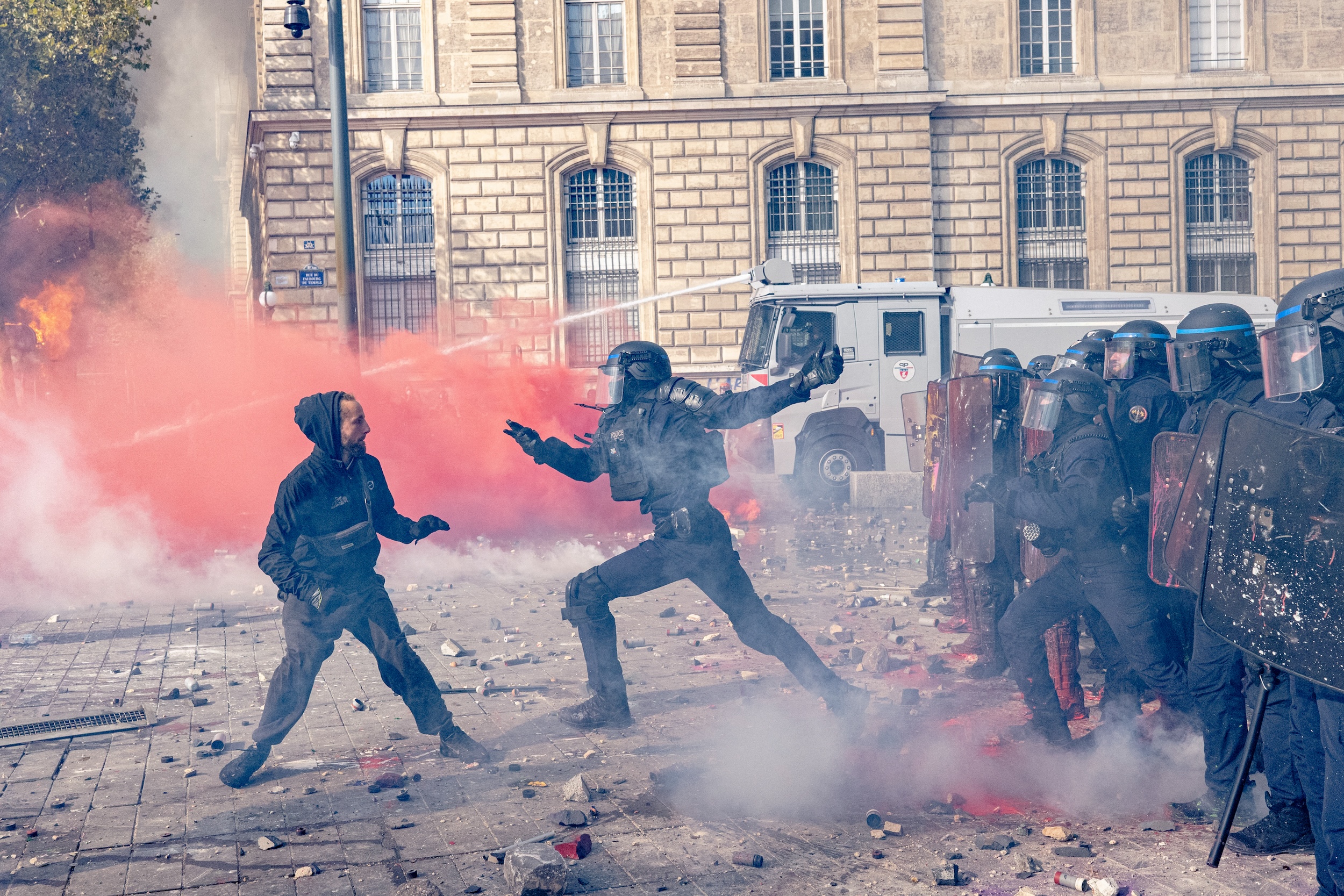
Mass protests during the day transformed into riots as evening fell, with multiple city halls and offices set ablaze or otherwise damaged. Police arrested some 2,400 protesters.
French leaders have placed blame on the protesters and the far left, including on the far left political party La France Insoumise (LFI), or France Unbowed. In a televised address Sunday, French President Emmanuel Macron said that the riots were caused by “groups from the far left, joined by a number of delinquents and criminals,” and spoke of police who were injured.
Macron attempted to differentiate between protesters with “legitimate grievances” and those who rioted, while stating that the cost-of-living crisis began because of the war in Iran and its effect on the cost of fuel — for which, he added, France is blameless, as it has not taken part in this war.
But while fuel prices have soared due to the U.S. and Israel’s war on Iran, there are much deeper grievances within France. The underlying causes of the unrest include racism and Islamophobia within France, as well as a decade of austerity policies under Macron alongside the rise of the far-right in the context of an upcoming election.
Marine Le Pen, head of the far-right National Rally party, also blamed “the extreme left” for the protests and riots, and specifically the leader of LFI, Jean-Luc Mélenchon. For his part, U.S. President Donald Trump once again blamed immigration, posting on his social media network Truth Social that France needs to “Close [its] Borders and take control.”
After state officials held crisis meetings on Monday, French Prime Minister Sébastien Lecornu announced that cities across France would impose partial curfews beginning on Monday night.
But while state media and right-wing leaders blamed the left, it is the police that have undertaken massive violence against protestors over the past month, including on Saturday.
In Paris on Saturday, police used tear gas and stun grenades against protesters even before the start of the demonstrations. John Mullen, an activist living in Paris, wrote that police “beat and injured thousands of protestors” as well as journalists and bystanders, and argued that police violence increased popular anger and led protesters to riot.
Manel ben Boubaker, a French teacher who joined the demonstrations in Paris, explained to Truthout that a “peaceful student-led march” faced “intense tear gas.” She described how police “effectively prevented [a protest] from taking place in and around Place de la République: people were blocked from entering, trapped inside, forced to retreat, and repeatedly tear-gassed in the surrounding streets. The violence was not confined to isolated clashes. It shaped people’s ability to gather, move through the square, and demonstrate at all.”
Read more Trump Admin Just Effectively Killed a Popular Renewable Energy Program
Left-wing LFI leader Mélenchon also blamed the police for inciting violence. Writing on X, he said that protesters were “calm and joyful everywhere when the police aren’t around.”
Last week, French lawyers and rights groups accused police of inflicting “war-like injuries” on youth protesters over the course of the past few weeks of student movement protests. On October 5, a 15-year-old had his hand blown off by a police stun grenade outside of a school protest, and during Saturday’s protests, a 17-year-old permanently lost vision in one eye after police fired a tear gas canister that hit her in the face.
Rayyan Seriket, a member of the French Student Union Federation, said in an interview on Democracy Now! Monday that Macron is blaming protesters for violence while excusing the violence of the police, whereas police violence is “the main violence, the real violence taking place in France” — underscoring that it is violence against children in particular.
During Saturday’s protests, demonstrators draped a giant yellow vest over the Statue of Marianne on the Monument a la Republique in Paris — on the vest was written “The police mutilate high school students” in French.
Students have also complained that the media has focused on acts of violence against property rather than on their demands. In an interview earlier last week, two unidentified young activists spoke of their demands and not being heard:
When you see 98 percent of news channels’ airtime is devoted to burning rubbish bins and only 2 percent to our demands, of course it makes us angry,” one student said. “We’re not happy, we’re not being listened to, we’re not being heard. And all the funding we’re demanding for schools, for our rights, and so on, they’re spending on repression instead. If they had listened to us from the beginning, maybe this would have already been resolved.
A second student reiterated the reasons for the continued youth mobilization. “We’re short of teachers, classrooms, chairs, social workers … Today, we can clearly see that young people’s mental health is deteriorating rapidly. We’re lacking all these things. This has created what you might call a widespread sense of frustration with the state, and that’s why so many of us are out protesting,” he said.
“I don’t think the movement will lose momentum. We’ll stay mobilized until the very end, until our demands are heard,” the young activist concluded.
More protests have been called for next Saturday, October 24, and unions have called for mass strikes on November 5.
France’s protest movement has caused waves across Europe, with similar youth-led protests emerging in Albania, Belgium, Italy, and beyond, also against austerity measures, neglect of public education, and the growth of far-right parties.
Read more “No Kings” Shifts Focus to Midterms With Early Voting Day of Action